Starting mechanical engineering can feel like stepping into a new world of heavy textbooks, unfamiliar terms, and complex math. But beneath all the theory lie five fundamental pillars that explain how everything around you works—from the bridge you cross to the engine in your car.
This guide breaks down each subject in plain language, ties it to real-life machines from your curriculum (based on the widely used textbook Basic Mechanical Engineering by Shanmugam & Ravindran), and ends with a practical study checklist and the most common questions beginners ask.
Let’s build your foundation.
Table of Contents
1. Statics: The Art of Standing Still
In simple terms: Statics studies forces on objects that are at rest or moving at a constant velocity. It answers the question: “Why doesn’t it collapse?”
Real-world example: A suspension bridge. The weight of vehicles pulls downward, but the cables and towers pull upward with equal force. When these forces balance, the bridge stays motionless. Even the belt drives and gear trains described in Chapter 5 of your textbook rely on static equilibrium to transmit power without breaking.
Core idea: If the sum of all forces and moments equals zero, the structure is safe. You’ll learn to draw free-body diagrams (FBDs) to map invisible forces. The free textbook Engineering Statics is your best companion for mastering this.

2. Dynamics: The Science of Motion
In simple terms: Dynamics deals with objects that accelerate, decelerate, or turn. While statics says “balance = no motion,” dynamics says “unbalance = motion begins.”
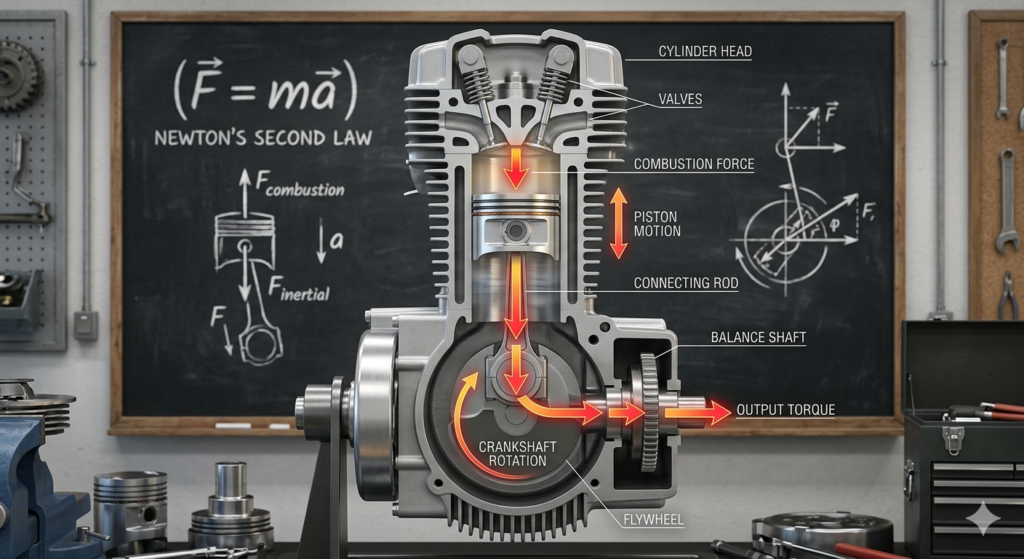
Real-world example: A motorcycle engine. The piston accelerates down after combustion, the crankshaft spins, and through gears the wheels rotate. The two-stroke petrol engine cycle explained in Chapter 4 is pure dynamics—every force and motion is perfectly timed.
Core idea: Newton’s second law ((F=ma)) rules here. A larger force makes a lighter object accelerate faster. You’ll study linear and rotational motion, torque, and kinetic energy.
3. Thermodynamics: Heat, Work, and Energy Conversion
In simple terms: Thermodynamics explains how heat transforms into work, and vice versa. It’s the reason engines produce power and refrigerators keep things cold.
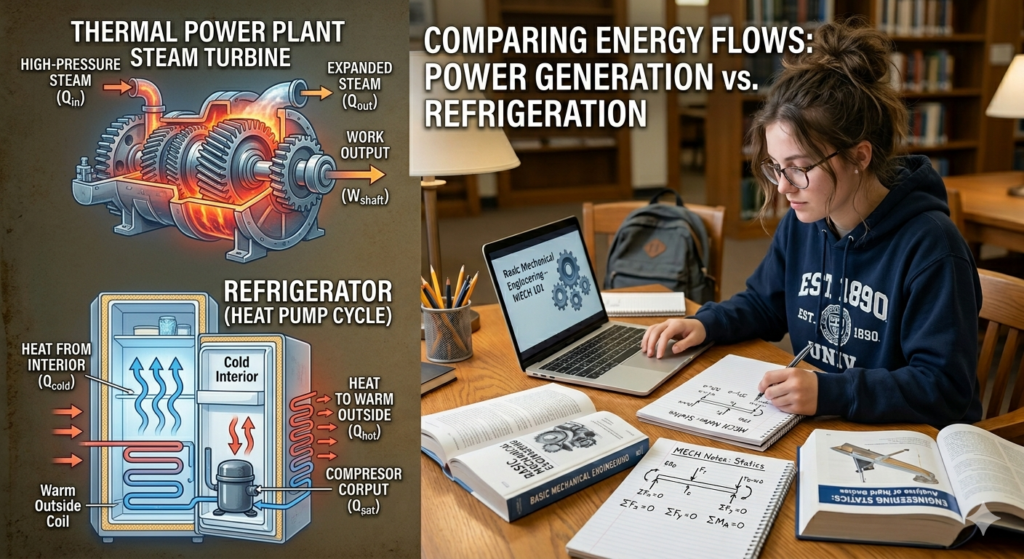
Real-world example: The steam turbine in a thermal power plant (Chapter 1). Fuel burns, water becomes superheated steam, the steam spins a turbine, and electricity is generated. Even the domestic refrigerator (Chapter 6) moves heat from inside to outside, using the same laws.
Core idea: Energy is conserved (First Law), but you can’t convert all heat into work; some always escapes (Second Law). That’s why no engine is 100% efficient.
4. Fluid Mechanics: The Flow of Liquids and Gases
In simple terms: Fluid mechanics studies how fluids (water, air, oil) behave when still and in motion. It covers everything from pipeline design to aircraft wings.
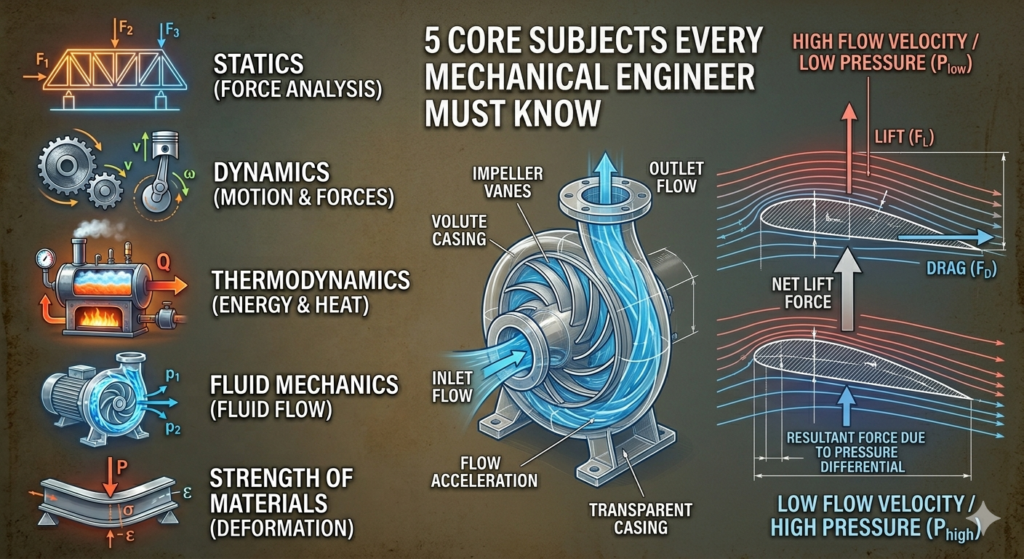
Real-world example: The centrifugal pump in Chapter 3. It pulls water from a well, accelerates it through a spinning impeller, and converts kinetic energy into pressure to lift water to a tank. The same principle pushes coolant through your car’s radiator.
Core idea: Fluids move from high pressure to low pressure. Faster flow means lower pressure (Bernoulli principle), which explains why an airplane wing generates lift.
5. Strength of Materials: Why Things Don’t Break
In simple terms: This subject examines how solid materials withstand forces—whether they bend, stretch, or fracture. It informs every single design decision.
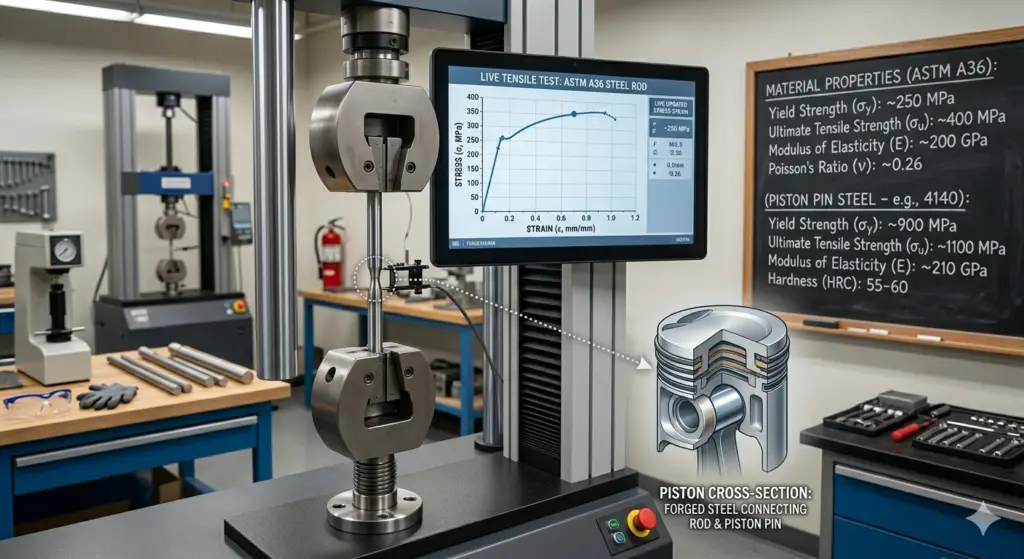
Real-world example: The connecting rod in an engine (Chapter 4). It endures explosive piston forces thousands of times per minute. If made too thin, it fails; too thick, it wastes weight. Strength of materials specifies the exact diameter and material. The discussion on cast iron, mild steel, and alloy steels (Chapter 11) shows how material choice matches the load.
Core idea: Stress is internal force; strain is the resulting deformation. Every material has limits (yield strength, ultimate tensile strength). Engineers design components to stay within the safe elastic zone.
How to Study These 5 Subjects: A Professor’s Checklist
- Develop physical intuition – Visualize forces, heat flow, fluid movement before writing equations.
- Draw free-body diagrams religiously – For statics and strength of materials, an FBD solves half the problem.
- Connect theory to machines – Every time you see a fan, pump, or engine, trace the forces and energy flow.
- Use the two core books – Basic Mechanical Engineering (for real-world devices and simple explanations) and Engineering Statics (for rigorous, no-cost statics practice).
- Solve problems in groups – Teaching others is the fastest way to master a concept.
- Don’t fear the math – Focus on the “why” first; formulas become tools later.
Frequently Asked Questions (FAQs)
What’s the actual difference between statics and dynamics?
Statics handles bodies at rest or moving at constant speed (acceleration = 0). Dynamics covers accelerated motion. Think of a parked car vs. a car speeding up or turning. In the curriculum, you’ll often study statics before dynamics because equilibrium concepts are foundational.
Do I have to love math to understand thermodynamics?
Not necessarily. You’ll need basic algebra and some calculus, but the core ideas—heat flows, efficiency limits—are logical. Many first-year thermodynamics problems rely on reading steam tables and applying simple formulas, which your textbook’s Chapter 1 explains step-by-step.
How is fluid mechanics different from thermodynamics?
Fluid mechanics focuses on the motion and pressure of liquids and gases, while thermodynamics deals with heat and energy conversion. They overlap in applications (e.g., a steam turbine uses both), but fluid mechanics answers “How fast does water flow?” whereas thermodynamics answers “How much work can that steam produce?”
Why do I need strength of materials if I’m not going to be a civil engineer?
Every machine part—shafts, gears, engine blocks—must handle forces without breaking. Strength of materials tells you the size, shape, and material required for safe operation. It’s essential for designing anything from a bicycle frame to a satellite component.
Is Basic Mechanical Engineering enough for my first-year exams?
Yes, it covers the entire syllabus of most Indian universities’ “Basic Mechanical Engineering” course. It includes steam boilers, IC engines, pumps, refrigeration, manufacturing processes, and even introductory CAD/CAM. Use it alongside lecture notes and practice problems.
Can I really learn statics from a free online textbook?
Absolutely. Engineering Statics (available on the Open Textbook Library) is written specifically for beginners, with clear diagrams and progressive examples. Many professors use it as a primary or supplementary text.
What’s the best way to use AI image prompts for study?
Generate diagrams to visualize abstract concepts. For instance, the prompt for a free-body diagram can help you confirm if your force arrows are correct. Use the images in your revision notes or presentations to strengthen your mental model.
How long does it take to master the five core subjects?
Mastery takes years, but you can build a solid working knowledge in your first two semesters. Dedicate consistent daily practice, relate concepts to real objects, and don’t hesitate to ask your professors or study group for help.
Best Books for Beginners
- Basic Mechanical Engineering by G. Shanmugam & S. Ravindran – The ideal first textbook, rich with diagrams, real-device descriptions, and simple language. Covers all five subjects through practical applications.
- Engineering Statics (Open Textbook Library) – A free, high-quality resource for mastering equilibrium, force analysis, and FBDs at your own pace.
Mechanical engineering is built on these five fundamental blocks. Understand them not as isolated chapters but as a connected framework that explains every machine around you. Grab your copy of Basic Mechanical Engineering, bookmark Engineering Statics, and start sketching your first free-body diagrams today. The world of engineering is waiting.