Table of Contents
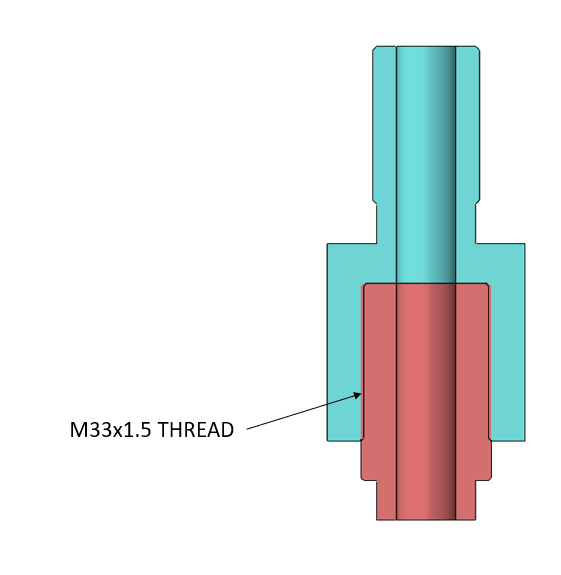
The Problem: A Leaky M33 Threaded Valve Joint
During the development of a high-pressure gas valve, we encountered a persistent sealing challenge. The design required a permanent, leak-tight connection between a titanium male plug (Ti-6Al-4V) and a 316L stainless steel female body, joined by an M33 × 2 metric thread. The assembly had to endure 200 bar operating pressure, thermal swings from –40 °C to +180 °C, and exposure to mildly acidic hydrocarbons — all while requiring zero maintenance over its lifetime.
Conventional sealing methods were tried first:
- PTFE tape extruded under load and cold-flowed at elevated temperatures.
- High-performance anaerobic thread sealants degraded chemically and lost adhesion during thermal cycling.
- An elastomeric O-ring seal demanded a groove that the compact valve design could not accommodate, and the temperature range exceeded typical elastomer limits.
Even tightening the plug to its maximum recommended preload failed to stop the leak. The root cause was not poor assembly, but the geometry of the thread itself: a continuous, invisible spiral channel that behaves as a leak highway under pressure and thermal cycling.
This article presents the engineering analysis behind a proposed solution: using controlled-atmosphere vacuum (or high-purity argon) brazing with an active filler metal to fill the thread clearance and convert the joint into a permanent, leak-tight metallic bond. It is not a certified procedure — it is the technical concept we developed, backed by well-established brazing fundamentals and literature data.
All foundational brazing principles — cleaning, gap control, capillary action, and atmosphere management — are detailed in the Lucas Milhaupt Brazing Fundamentals.
Why This Problem Is Particularly Difficult
Sealing a threaded joint between titanium and stainless steel sits at the intersection of several tough engineering challenges. It is not merely about picking a better sealant — the fundamental material properties work against you.
Dissimilar Metal Joining
Titanium and stainless steel cannot be fusion welded. At welding temperatures, molten iron and titanium mix to form brittle intermetallic phases (TiFe, TiFe₂) that crack as the joint cools. Any permanent joining method must avoid melting the base metals entirely.
Thermal Expansion Mismatch
The linear coefficient of thermal expansion for Ti-6Al-4V is about 8.6 µm/m·K, while 316L stainless steel expands at roughly 16.0 µm/m·K. Every temperature cycle causes the steel body to “breathe” relative to the titanium plug, opening and closing the thread clearance and pumping fluid through the helix. Any seal must be mechanically compliant enough to absorb this differential strain without cracking.
Titanium’s Extreme Reactivity
At elevated temperatures, titanium reacts instantly with oxygen, nitrogen, and hydrogen. A tenacious titanium dioxide (TiO₂) layer forms in milliseconds, and inward oxygen diffusion creates a brittle “alpha-case” surface. For brazing to work, the titanium surface must be kept clean until the filler wets it — which is nearly impossible in open air without an aggressive flux, and even then, flux residues can create their own long-term corrosion risks.
The Helical Leak Path
A standard M33 × 2 thread with 22 mm of engagement contains a spiral path nearly 500 mm long. Even under heavy torque, the flanks and roots of the threads never achieve 100% contact; microscopic surface roughness leaves interconnected voids. Under pressure, gas snakes its way through this labyrinth.
These combined challenges eliminate most off-the-shelf sealing solutions. They also make the brazing approach far from trivial.
Key Engineering Insight
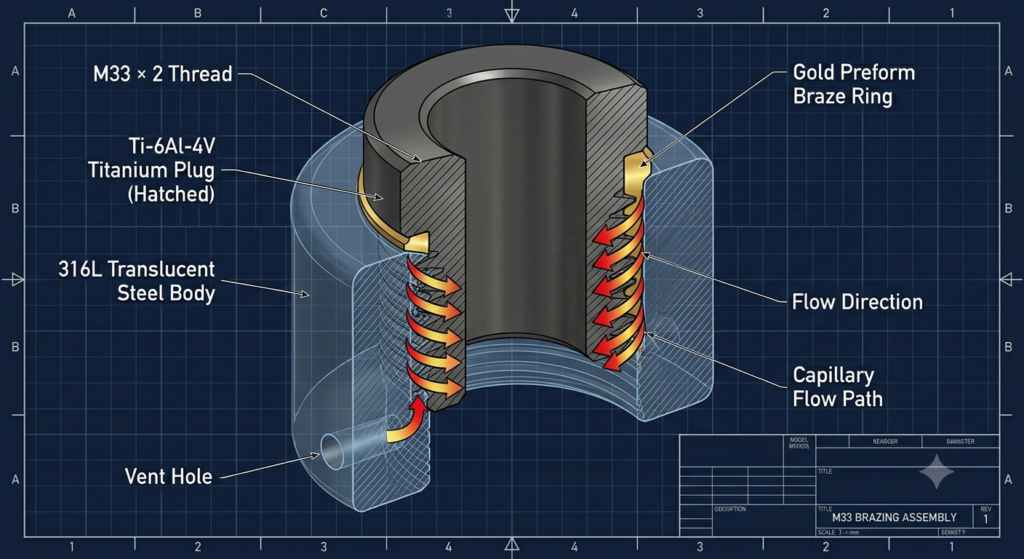
Instead of seeing the thread clearance as a flaw to be crushed or filled with a polymer, we treated it as a 500 mm long helical capillary — a feature to be used, not removed. By controlling the gap size and creating ultra-clean, oxide-free surfaces, we could draw a molten brazing alloy through the entire thread by capillary action alone. The very geometry that caused the leak would become the delivery channel for a permanent, metallic seal.
Choosing the Brazing Route: Why Vacuum/Inert Atmosphere?
Once we concluded that brazing was the only viable permanent sealing method, the next decision was the process atmosphere. We considered two paths:
1. Open-Air Torch Brazing with Flux
- Advantages: Simple equipment, low cost, good for prototyping.
- Disadvantages: Requires an aggressive fluoride-based flux to cut titanium oxides. Flux residues can be trapped in the thread, causing future corrosion. Even with argon internal purge, achieving the target helium leak rate of <1×10⁻⁸ mbar·L/s is extremely difficult and unrepeatable.
2. Controlled-Atmosphere Brazing (Vacuum or High-Purity Argon)
- Advantages: Eliminates flux entirely. Active filler metals can wet titanium directly in a clean atmosphere. The entire joint is heated uniformly, reducing thermal gradients. The result is a clean, void-free joint with no corrosive residues. It is the process of choice for aerospace, medical, and high-reliability valve components.
- Disadvantages: Requires a vacuum furnace or a sealed argon glovebox/retort with oxygen monitoring. Higher capital cost and longer cycle times.
For a permanent seal that must withstand years of thermal and chemical cycling, vacuum/argon brazing with an active filler was the clear engineering choice.
The Active Filler Metal: Enabling Fluxless Wetting on Titanium
The filler alloy we selected is a commercially available 60Ag‑30Cu‑10Ti (wt%) active brazing alloy, typically supplied as wire 1.0 mm in diameter. This alloy is widely documented for joining ceramics, titanium, and stainless steel.
How it works: The 10% titanium content in the filler acts as an active element. When the alloy melts under a vacuum or inert atmosphere with very low oxygen partial pressure, the titanium in the liquid filler reacts with the thin oxide layer on the titanium base metal, disrupting it and allowing the molten filler to wet the surface directly. No external flux is needed. The silver-copper matrix provides excellent ductility, helping the joint accommodate the thermal expansion mismatch between the two base metals.
The filler’s melting range (approximately 780–810 °C) lies below the temperature range where rapid alpha-case formation occurs on Ti-6Al-4V, and well below the sensitization range of 316L. Short hold times at brazing temperature further limit any intermetallic growth at the steel-titanium interface.
Designing the Joint as a Capillary System
The success of this concept rests on turning the thread into a reliable capillary channel. Key design parameters:
1. Thread Fit and Clearance Control
The M33 × 2 thread is spec’d to a 6H/6g fit. However, within that standard, the actual pitch diameter can be adjusted to achieve a target radial clearance of approximately 0.05–0.15 mm at room temperature. Given that stainless steel expands roughly twice as much as titanium, the hot clearance at 800 °C may open to 0.10–0.20 mm. This range is excellent for capillary flow of silver-based brazing alloys — wide enough to allow filler to flow, but narrow enough to sustain strong capillary forces.
Exact gap must be verified experimentally with the actual parts because thread tolerances stack up. Too wide a gap, and capillary action fails; too tight, and filler may not enter at all.
2. Filler Placement
A small preform ring made from the filler wire is placed in a shallow counterbore at the start of the female thread, or simply seated at the thread entry. When the assembly is heated above the filler’s liquidus, this preform melts and is drawn into the helical path. Alternatively, wire-feed (manual or automated) can be used, but a preform ensures a known alloy volume.
3. Venting
A 0.8 mm diameter vent hole is drilled through the steel body at the far end of the thread engagement. This vent allows expanding air, residual moisture, or any evolved gases to escape. Without it, gas pockets can block filler flow and leave voids. The vent is placed diametrically opposite the filler entry to force the alloy to traverse the full helix.
Proposed Brazing Procedure Outline
The following procedure is a recommended starting point based on established active brazing practices. It must be optimized for the actual parts and furnace equipment through systematic trials.
Step 1: Cleaning and Preparation
All handling performed in a clean environment with nitrile gloves.
- Stainless steel body: Ultrasonic degrease (acetone, then IPA). Acid pickle with a paste of 20% HNO₃ + 2% HF for 5 minutes to remove chromium oxides. Rinse with deionized water and dry with hot filtered nitrogen.
⚠ Hydrofluoric acid is extremely hazardous; only trained personnel with full HF-rated PPE should perform this step. - Titanium plug: Immediately before assembly, pickle in 30% HNO₃ + 3% HF for 45–60 seconds. Rinse thoroughly with DI water, dry with hot nitrogen, and transfer directly into the argon glovebox or vacuum chamber.
Step 2: Assembly and Filler Placement
- Inside an argon-purged glovebox (O₂ < 1 ppm, H₂O < 1 ppm) or using a rapid transfer system, place the Ag-Cu-Ti wire preform at the thread entry.
- Thread the titanium plug into the steel body hand-tight plus a small additional turn (e.g., 1/8 turn) to ensure consistent thread engagement without galling.
Step 3: Brazing Thermal Cycle
- Place the assembly in a vacuum furnace (<5×10⁻⁵ mbar) or a sealed retort backfilled with ultra-high-purity argon.
- Example profile:
- Ramp 10–15 °C/min to 600 °C, hold 20–30 min for thermal equalization.
- Ramp to 820 °C ±5 °C, hold 3–5 minutes.
- Furnace cool to below 100 °C before exposure to air.
- Total time above 750 °C should be minimized (target <10 min) to limit intermetallic growth.
Step 4: Inspection
- No flux removal is needed. Visually inspect the fillet at both ends of the thread — a smooth, slightly concave surface indicates filler flow.
- Perform helium leak testing to verify seal integrity. Destructive cross-sectioning of a few samples will validate filler penetration and intermetallic thickness.
Expected Performance and Validation Goals
Based on published data for similar Ag-Cu-Ti brazed dissimilar-metal joints, the following performance targets are realistic and can be used as validation criteria:
| Parameter | Target / Expected Value |
|---|---|
| Helium leak rate (sniffer) | <1×10⁻⁸ mbar·L/s |
| Hydrostatic pressure test | 1.5× design pressure (300 bar), no leakage |
| Thermal cycling endurance | –40 °C to +180 °C, multiple cycles, no degradation |
| Intermetallic layer thickness | <5 µm, uniform, no cracking |
| Filler penetration | 100% through entire thread length (X-ray CT or sectioning) |
These targets are achievable only if process parameters are tightly controlled and the joint design follows the capillary principles described earlier.
Key Lessons from Similar Active Brazing Applications
Drawing from industry experience and published case studies, several critical success factors stand out for threaded titanium-steel brazing:
- Clearance optimization is everything. The thread gap must be large enough to allow flow but small enough for capillary action. A hot clearance of 0.10–0.20 mm is a good starting range for Ag-Cu-Ti fillers, but each thread geometry should be verified with test coupons.
- Venting is mandatory. Blind assemblies without a vent will inevitably have incomplete fill. A strategically placed 0.8 mm vent hole solves this without compromising structural integrity.
- Atmosphere quality must be monitored. Active fillers can fail to wet if the oxygen level in an “argon” glovebox rises above a few ppm. Continuous oxygen and dew point monitoring during the cycle adds confidence.
- Thermal soak at 600 °C equalizes the part. Since the steel body heats and expands faster than the titanium plug, a soak at an intermediate temperature ensures a uniform gap when the filler melts.
- Intermetallic thickness must be controlled. The brittle reaction layer at the titanium interface grows with time and temperature. A short hold at brazing temperature and rapid cooling help keep it thin and crack-free.
- Fixturing matters. Any relative movement during brazing can break capillary flow or cause misalignment. Simple tack welds on the steel side (not the titanium) or a stable graphite fixture can hold the assembly.
Future Validation Work
To move this concept from paper to a qualified production joint, the following steps are planned (or recommended):
- Brazing coupon trials using M33 thread replicas to optimize preform size, vent placement, and furnace profile.
- Metallographic examination of cross-sectioned joints (optical microscopy, SEM/EDS) to measure filler penetration, void percentage, and intermetallic layer thickness.
- Helium leak testing per ASTM F2094 or equivalent, correlating leak rate with process parameters.
- Thermal cycling evaluation followed by retesting to confirm seal stability.
- Burst and hydrostatic pressure testing to establish ultimate margin of safety.
These data will form the basis of a certified brazing procedure specification (BPS) for production use.
Frequently Asked Questions
Can titanium be brazed to stainless steel without flux?
Yes, when an active filler metal (such as Ag-Cu-Ti) is used in a vacuum or high-purity inert atmosphere. The active element in the filler disrupts the titanium oxide layer, enabling direct wetting without external flux.
Why not weld titanium to stainless steel?
Fusion welding causes extensive mixing of the two metals, forming brittle iron-titanium intermetallics that crack upon cooling. Brazing avoids melting the base metals, limiting the reaction to a thin, controllable layer.
What temperature is needed for Ag-Cu-Ti brazing?
The filler melts around 780–810 °C. A brazing temperature of 820 °C is typical to ensure good flow, but exact parameters depend on part mass and furnace characteristics.
Is this concept limited to valves?
No. The helical capillary approach can be applied to any threaded connection that requires a permanent, leak-tight metal seal — sensor housings, cryogenic fittings, pressure vessel bosses, etc.
Do I need a vacuum furnace, or can I use a simple argon purge?
A vacuum furnace provides the most reliable atmosphere. A sealed retort with high-purity argon and real-time oxygen monitoring can also work, but a simple open-tube purge is generally insufficient for active filler wetting on titanium.
Conclusion
The leaking M33 titanium-to-steel valve thread was not a failure of sealing technology — it was a failure of the standard approach. By rethinking the thread as a helical capillary and choosing vacuum brazing with an active filler, we developed an engineering concept that targets a permanent, hermetic seal without the long-term weaknesses of polymer sealants or the impossibility of welding.
This article has outlined the problem analysis, the material challenges, the joint design, and the proposed brazing route. While the process parameters and performance targets are representative and require experimental validation on real parts, the underlying solution is grounded in sound metallurgical principles and real-world brazing practice.
For engineers facing similar sealing challenges with dissimilar threaded connections, this approach offers a path worth exploring — one that turns the thread’s geometry from a liability into the very means of its own permanent seal.
Are you working on a valve or fluid system that demands a permanent, leak-tight threaded joint? The MechConcepts team can help you assess feasibility, design the joint, and develop a validated brazing process. Contact us to start the conversation.