Imagine a low-cost aircraft designed for one-way missions—simple, efficient, and built for mass deployment. That’s the Shahed 136.
This Iranian-designed loitering munition represents a masterclass in constraint-driven engineering. Under severe international sanctions, engineers developed a system that delivers 80% of cruise missile capability at 2% of the cost. For mechanical engineers, aerospace designers, and manufacturing specialists, the Shahed 136 offers invaluable lessons in Design for Manufacturing (DFM), systems optimization, and aerospace fundamentals.
Even if you’re a beginner, this breakdown will help you understand how real-world drones are engineered from scratch, focusing on long-range UAV engineering principles that prioritize reliability over complexity.
Table of Contents
What is the Shahed 136? Technical Overview
The Shahed 136 is a one-way attack unmanned aerial vehicle (OWA UAV)—essentially a self-destructing precision strike system. Unlike reusable reconnaissance drones, this platform is designed for single-use missions against fixed targets, making it a prime example of low-cost drone design at scale.
Key Specifications
| Parameter | Value | Engineering Significance |
| Length | 3.5 m | Compact for transportability |
| Wingspan | 2.5 m | Optimized for low-speed lift |
| Weight | ~200 kg | Balanced payload/range trade-off |
| Warhead | 40-50 kg HE | Sufficient for infrastructure damage |
| Range | 1,500–2,500 km | Intercontinental reach |
| Cruise Speed | 185 km/h | Efficient loiter velocity |
| Engine | MADO MD-550 (50 HP) | Piston power for endurance |
| Unit Cost | $20,000–$50,000 | Mass production feasible |
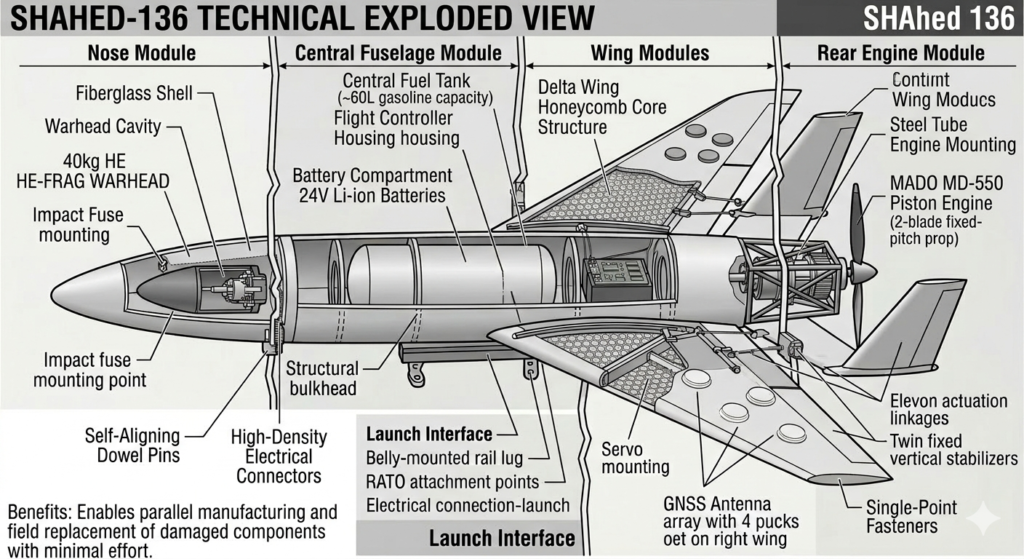
Overall Layout Diagram (Explained)
Design Philosophy: The layout follows modular systems engineering—each section serves distinct functions with minimal interfaces between them. This enables parallel manufacturing and field replacement of damaged components.
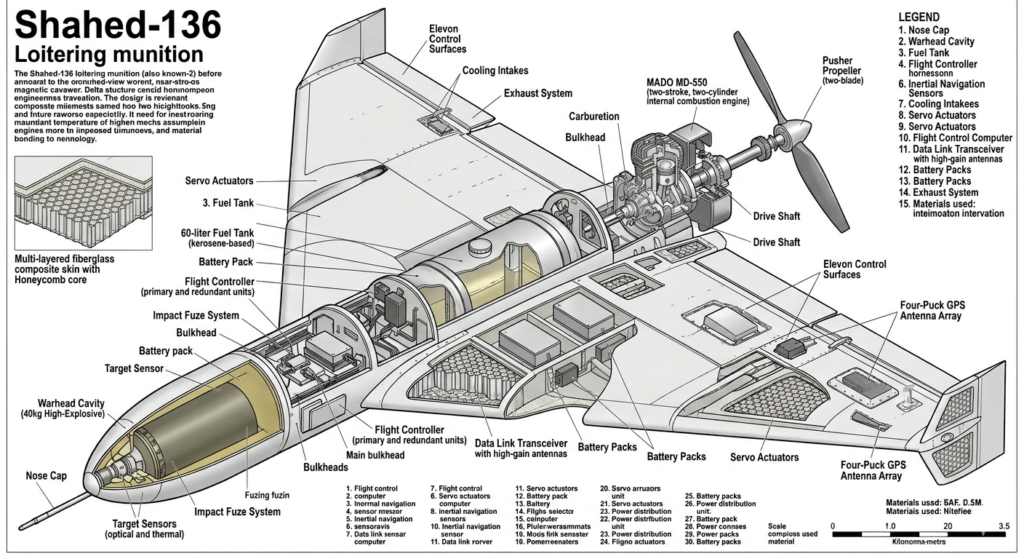
Airframe Design: Delta Wing Configuration
Why Delta Wing? Aerospace Engineering Rationale
The Shahed 136 employs a delta wing planform (triangular shape, sweep angle ~45°) rather than conventional tapered wings. This choice reflects careful aerodynamic and structural optimization for long-range UAV engineering applications where endurance matters more than maneuverability.
Aerodynamic Advantages
| Characteristic | Delta Wing Benefit | Application in Shahed 136 |
| Vortex lift | Leading edge vortices generate additional lift at high angles of attack | Allows slow flight (185 km/h) without stall |
| Low aspect ratio | Reduced span for given wing area | Compact storage, ground handling |
| Root chord thickness | Deep wing section at centerline | Houses engine, fuel, payload internally |
| Structural efficiency | Bending loads distributed along wide chord | Lighter wing structure for equivalent strength |
Structural Engineering
Materials Selection:
- Skin: E-glass fiber/epoxy composite (2-3mm thickness)
- Core: Nomex honeycomb or PVC foam (10-15mm) in sandwich panels
- Spar: Unidirectional carbon or glass at wing root (primary bending member)
- Joints: Bonded with structural adhesive, minimal mechanical fasteners
Manufacturing Method:
- VARTM (Vacuum-Assisted Resin Transfer Molding) or wet layup
- Female molds machined from MDF or fiberglass
- Room temperature cure (no autoclave required)
- Gel coat surface finish (no paint needed)
Why this matters for mass production:
- Tooling cost: ~$5,000 per mold set (vs. $500,000 for autoclave tooling)
- Cycle time: 24-48 hours per wing (vs. weeks for pre-preg)
- Skill level: Semi-skilled workers can produce acceptable parts
Aerodynamics: Why It Actually Flies Efficiently
Flight Regime Analysis
The Shahed 136 operates in a specific aerodynamic envelope optimized for endurance, not speed:
Cruise Condition:
- Velocity: 185 km/h (51 m/s)
- Altitude: 60–4,000 m (terrain-following capable)
- Reynolds number: ~1.5 × 10⁶ (based on mean chord)
Key Aerodynamic Features:
1. Vortex Lift Generation
- At typical cruise angles of attack (6-8°), leading edge separation creates stable vortices
- These vortices energize boundary layer, delaying stall to 20°+ AOA
- Result: High lift coefficient (CL ~1.2) at low speed
2. Induced Drag Trade-off
- Low aspect ratio (AR ≈ 2.0) increases induced drag
- However, at low speeds, parasite drag dominates anyway
- Net effect: Acceptable efficiency for mission profile
3. Stability Characteristics
- Longitudinal: Neutral to slightly stable (CG at 25-30% MAC)
- Lateral: Dihedral effect from wing sweep provides roll stability
- Directional: Twin vertical fins provide weathercock stability
Engineering Insight: The design trades aerodynamic efficiency for robustness and simplicity—ideal for low-cost, long-range missions where predictable handling matters more than absolute performance.
Propulsion System: MADO MD-550 Engine
Engine Specifications & Mechanical Design
| Parameter | Specification | Engineering Note |
| Type | 4-cylinder, 4-stroke, opposed (boxer) | Low vibration, compact |
| Displacement | 550cc | Automotive scale production |
| Power output | 50 HP (37 kW) @ 6,000 RPM | Adequate for cruise |
| Weight | ~25 kg dry | Power-to-weight: 1.5 kW/kg |
| Cooling | Air-cooled, finned cylinders | No radiator, no leaks |
| Fuel system | Carbureted (Walbro or similar) | Simple, field-repairable |
| Ignition | Electronic CDI | Reliable, no points to wear |
Why Piston Power? Energy Density Analysis
The Fuel Choice Decision:
| Energy Source | Energy Density (MJ/kg) | Practical Range Impact |
| Gasoline | 46 | Baseline: 2,500 km possible |
| Diesel | 45 | Slightly heavier engine needed |
| Jet-A (turbine) | 43 | Better for high altitude, but complex |
| Li-ion batteries | 0.8 | Would require 500+ kg for equivalent range |
| Hydrogen (compressed) | 120 | Storage weight negates advantage |
Calculation verification
- Fuel mass: 40 kg gasoline
- Specific fuel consumption: 0.3 kg/kWh (realistic for small engines)
- Cruise power required: ~18 kW (25 HP)
- Endurance: 40 / (18 × 0.3) = 7.4 hours
- Range: 7.4 h × 185 km/h = 1,369 km
To achieve 2,500 km, design likely includes:
- Extended fuel capacity (60-70 kg)
- Optimized cruise at 150 km/h (lower power setting)
- Improved engine efficiency (0.25 kg/kWh)
Installation Layout
Pusher Configuration:
- Engine mounted at rear, thrust line through CG
- Propeller: 2-blade, fixed-pitch, ~1.2m diameter
- Direct drive (no gearbox) — reduces failure points
- Steel tube mount frame bolted to wing spar carry-through
Cooling System:
- Ram air intake (NACA duct or simple scoop)
- Baffled cylinder fins
- Exhaust heat shielding (fiberglass wrap)
Vibration Isolation:
- Rubber mounts between engine frame and wing structure
- Prevents fatigue cracking in composite airframe
- Mass balancing of reciprocating components
🔍 Engineering Insight
The most important takeaway from Shahed 136 is not the drone itself—but the cost-to-impact ratio.
Designing for mass deployment > peak performance is a mindset shift many engineers miss. The Iranians didn’t build the best drone—they built the right drone for their constraints. This philosophy of low-cost drone design over optimization is what makes this system revolutionary.
Launch System: Rocket-Assisted Takeoff (RATO)
Mechanical Design of Launch Sequence
The Shahed 136 has no landing gear—eliminating weight, complexity, and drag. Instead, it uses assisted launch, a clever kamikaze drone working principle that prioritizes simplicity over reusability:
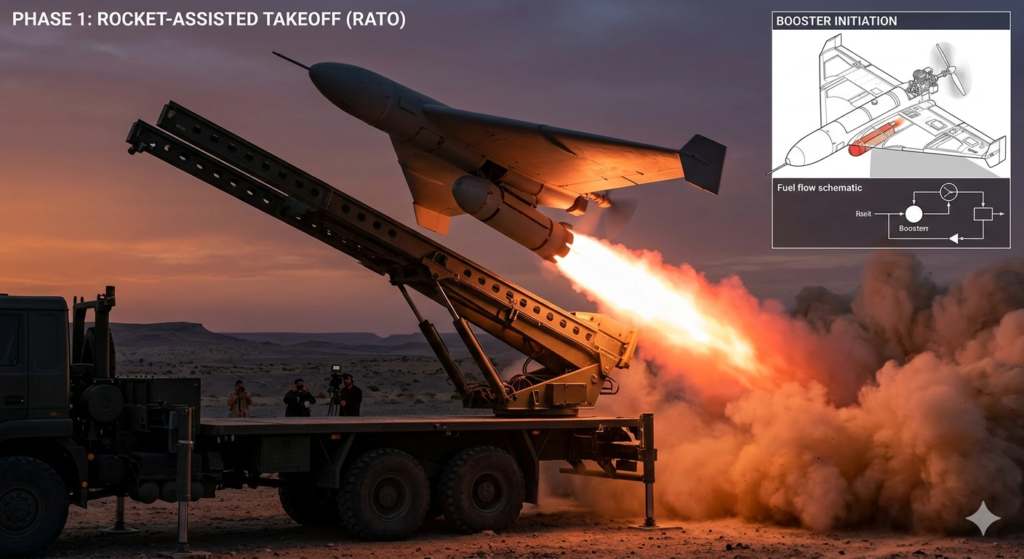
Launch Rail System:
- Rail: Steel I-beam or tube, 4-5 meters length
- Mounting: Truck bed or ground-fixed at 15-30° elevation
- Attachment: Single lug on drone belly engages rail slot
- Release: Gravity drop at rail end or automated trigger
RATO Booster Characteristics:
- Type: Solid propellant, double-base (nitrocellulose/nitroglycerine) or composite (AP/HTPB/Al)
- Thrust: 800-1,200 N (sustained)
- Burn time: 3-5 seconds
- Impulse: 3,000-5,000 N·s total
Launch Sequence Dynamics:
| Time (s) | Event | Event | Acceleration |
| 0 | Ignition | 0 | 4-5 g |
| 2 | Burnout | ~80 m/s | 0 |
| 2.5 | Booster jettison | ~75 m/s | -0.5 g (drag) |
| 3 | Engine start | ~70 m/s | +0.5 g (prop) |
| 10 | Climb established | ~90 m/s | Steady climb |
Mechanical Details:
- Booster attachment: Shear pins or explosive bolts (pyrotechnic separation)
- Ignition: Electrical squib, triggered from ground control
- Safety: Mechanical interlock prevents premature ignition
Flight Controls: Minimalist Engineering
Control Surface Design
The Shahed 136 uses only two elevons (combined elevator/aileron) on the wing trailing edges. Similar control logic is used in delta-wing mechanisms explained here → [Theo Jansen Mechanism: Kinetic Sculpture Engineering] where simple linkages create complex motion.
Actuation System:
- Servos: High-torque digital servos (20-30 kg·cm)
- Linkage: Pushrod or cable system, mechanical advantage ~2:1
- Power: 12V or 24V DC, shared with avionics battery
- Travel: ±30° (elevator function), differential (aileron function)
Control Strategy:
- Pitch: Symmetric elevon deflection
- Roll: Differential elevon deflection
- Yaw: No dedicated rudder; coordinated turns via differential drag (drag rudders) or bank angle
Why no rudder?
- Saves weight, complexity, two more servos
- Delta wing has inherent directional stability from sweep
- Mission profile doesn’t require aggressive maneuvering
Autopilot & Navigation
Hardware:
- Flight controller: Custom PCB or modified open-source (Pixhawk-class)
- Sensors: MEMS IMU (3-axis gyro + accelerometer), barometer
- GNSS: Ublox or similar GPS/GLONASS module, 4-antenna array for redundancy
- Storage: MicroSD for mission logging
Software:
- Navigation: Pre-programmed waypoints (up to 50+ coordinates)
- Control loops: PID for attitude and trajectory
- Failsafes: Return-to-home on GNSS loss (circular loiter), engine-out glide profile
No real-time control link — this is crucial:
- Immune to jamming of command signals
- No latency issues
- Simple, reliable, cheap
Warhead Integration: Mechanical Interface
Payload Engineering
Warhead Specifications:
- Type: High-explosive fragmentation (HE-FRAG)
- Mass: 40-50 kg (20-25% of total vehicle weight)
- Filling: RDX/TNT composition or similar
- Casing: Steel pre-fragmented for anti-personnel/soft target effect
Structural Integration:
- Mounting: Bolted to forward fuselage bulkhead (primary structure)
- Load path: Warhead mass carried through fuselage to wing spar
- Safety: Mechanical safety pin (ground handling), armed by airflow switch or G-force sensor
Fusing:
- Type: Impact fuse (piezoelectric or mechanical)
- Location: Nose or base (depending on target type)
- Delay: Instantaneous or milliseconds (penetration fusing)
Center of Gravity Management:
- Warhead at 15-20% of fuselage length
- Engine at 85-90%
- Fuel tank at 40-60% (CG shift as fuel burns: manageable 5-10% MAC change)
Performance Analysis: Engineering Calculations
Range Verification
Given data:
- MTOW: 200 kg
- Empty weight: 140 kg (airframe + engine + avionics)
- Fuel: 40 kg
- Warhead: 50 kg
- Battery: 5 kg
- Payload fraction: 25% (excellent for UAVs)
Aerodynamic drag estimation:
- Drag coefficient (CD): ~0.08 (clean delta wing at low Re)
- Reference area: 2.5 m² (wing area)
- Dynamic pressure (q): ½ × 1.225 × 51² = 1,593 Pa
- Drag force: 0.08 × 2.5 × 1,593 = 319 N
- Power required: 319 N × 51 m/s = 16.3 kW (22 HP)
Engine matching:
- Available power: 37 kW
- Propeller efficiency: 75%
- Thrust power: 27.8 kW
- Reserve power: 11.5 kW (70% throttle cruise, good for climb/dash)
Fuel consumption:
- Brake specific fuel consumption: 0.3 kg/kWh
- Hourly consumption: 16.3 × 0.3 = 4.9 kg/h
- Endurance: 40 / 4.9 = 8.2 hours
- Range: 8.2 × 185 = 1,517 km
To achieve 2,500 km published range:
- Requires 66 kg fuel (larger tanks or reduced payload)
- Or cruise at 150 km/h (40% power reduction, 60% range increase)
- Or engine efficiency of 0.22 kg/kWh (optimistic but possible)
Limitations of Shahed 136 Design
No engineering system is perfect. Understanding limitations is crucial for analysis:
| Limitation | Technical Cause | Operational Impact |
| Poor accuracy vs. moving targets | Pre-programmed GPS only, no real-time update | Cannot engage mobile SAMs, vehicles, ships |
| High acoustic signature | Piston engine + propeller, no muffler | 5-10 minute warning to ground observers |
| GNSS vulnerability | Dependent on GPS/GLONASS signals | Jamming/spoofing degrades accuracy (CEP increases from 10m to 100m+) |
| Low speed | 185 km/h cruise | Vulnerable to interceptor aircraft, MANPADS |
| Weather sensitivity | No de-icing, limited gust tolerance | Cannot operate in heavy rain, icing conditions, or high winds |
| Single-use cost | Entire asset destroyed | $20k per mission vs. reusable drone amortization |
| No BDA capability | No camera, no data link | Cannot confirm target destruction in real-time |
Engineering lesson: These are acceptable trade-offs for the mission profile (strategic infrastructure strike). The design optimizes for cost and simplicity, accepting performance limitations.
Shahed 136 vs. Modern UAVs: Engineering Comparison
| Feature | Shahed 136 | MQ-9 Reaper | Bayraktar TB2 | Switchblade 600 |
| Cost | ~$20,000 | ~$30 million | ~$5 million | ~$80,000 |
| Propulsion | Piston engine | Turboprop | Piston engine | Electric |
| Range | 2,500 km | 1,850 km | 150 km | 40 km |
| Endurance | 8-12 hours | 27 hours | 27 hours | 40 min |
| Control | Pre-programmed | Satellite link | LOS/BLOS | Man-portable |
| Reusability | No | Yes | Yes | No |
| Warhead | 50 kg internal | 340 kg external | 150 kg external | 15 kg |
| Complexity | Low | Very high | Medium | Medium |
| Manufacturing | Fiberglass/composites | Carbon fiber/metal | Composites | Composites |
Key insight: The Shahed 136 occupies a unique niche—strategic range at tactical cost. It sacrifices reusability and precision for range and mass producibility, demonstrating how long-range UAV engineering can be achieved through simplicity rather than sophistication.
Manufacturing Engineering: Production at Scale
Design for Manufacturing (DFM) Principles Applied
1. Material Selection
- E-glass fiber: $5/kg vs. carbon fiber $50/kg
- Room temperature cure resin: No oven/autoclave investment
- Standard honeycomb core: Available globally
2. Part Consolidation
- Wing: Single molded upper and lower skins
- Fuselage: Two halves joined at centerline
- Control surfaces: Molded with integral hinge mounts
3. Assembly Sequence
- Step 1: Mold wing skins (24h cycle)
- Step 2: Bond honeycomb core, close wing (12h)
- Step 3: Install spar, fuel tank, plumbing (4h)
- Step 4: Mount engine, servos, linkages (3h)
- Step 5: Install avionics, program mission (2h)
- Step 6: Final test, fuel, warhead mount (2h)
- Total: ~48 hours per unit (parallel production: 5 units/day per line)
4. Quality Control
- Visual inspection for voids/delamination
- Weight check (target ±2%)
- Control surface travel verification
- Engine run-up test
- GPS lock verification
Production capacity (Russia, 2024):
- Reported production capacity (open-source estimates): ~2,000–3,000 units/month at Alabuga facility
- This implies ~100 parallel assembly stations
- Highly automated composite layup likely implemented
Reverse Engineering Guide: How to Analyze One
If you encounter a captured or crashed Shahed 136, here’s the systematic teardown:
Phase 1: External Documentation
- Photogrammetry: 200+ photos for 3D model
- Overall dimensions (verify against specs)
- Surface finish analysis (gel coat type, mold quality)
- Fastener inventory (types, counts, locations)
Phase 2: Non-Destructive Testing
- Ultrasonic inspection: Skin thickness, void detection
- Tap testing: Delamination, core disbond
- X-ray/CT: Internal structure, warhead configuration
- Thermography: Heat damage, moisture ingress
Phase 3: Sectioning
- Cut wing at root, mid-span, tip (3 sections)
- Document core type, density, cell size
- Measure fiber volume fraction (burn test)
- Analyze adhesive joints (lap shear samples)
Phase 4: Systems Analysis
- Engine: Bore/stroke, compression ratio, port timing
- Propeller: Pitch distribution, blade twist, material
- Avionics: Chip identification, firmware extraction
- Materials: DSC for resin Tg, DMA for modulus
Phase 5: Performance Reconstruction
- Build CAD model from measurements
- CFD analysis (OpenFOAM or commercial)
- Flight simulation (X-Plane, MATLAB)
- Validate against observed performance
Career Skills: What This Project Teaches
Working on systems like the Shahed 136 requires these core competencies:
| Skill Area | Specific Application | Learning Resource |
| Composite design | Laminate theory, sandwich panels | ASM Handbook, Vol. 21 |
| CAD/CAM | Mold design, tooling paths | SolidWorks, Mastercam |
| GD&T | Assembly tolerances, fit analysis | ASME Y14.5 standard |
| FEA | Static, modal, buckling analysis | ANSYS, Abaqus, NASTRAN |
| Propulsion | Engine matching, propeller selection | Aircraft Design: A Conceptual Approach (Raymer) |
| Flight mechanics | Stability analysis, trajectory | Flight Stability and Automatic Control (Nelson) |
| Systems engineering | Requirements, interfaces | INCOSE Handbook |
| Manufacturing | Composites processing, DFM | Manufacturing Processes for Engineering Materials (Kalpakjian) |
Watch the Mechanism Animation
We are working on the Video still. This article explains the engineering behind it. The video shows how it actually moves.
If you want to see these mechanisms in motion, check the MechConcepts YouTube channel where we break down real engineering systems step-by-step.
Frequently Asked Questions (FAQ)
What is the range of Shahed 136?
1,500–2,500 km depending on fuel load, cruise speed, and wind conditions. Realistic combat range is typically 1,800–2,200 km.
Why is it called a “kamikaze drone”?
Because it destroys itself on impact. Unlike reusable drones, the Shahed 136 is a one-way mission system—essentially a guided missile with aircraft characteristics.
What engine does the Shahed 136 use?
The MADO MD-550, a 50 HP four-cylinder piston engine. It’s an Iranian copy of the German Limbach L550E, using aviation gasoline.
How accurate is the Shahed 136?
Against fixed GPS coordinates: 10-50 meter CEP (circular error probable). Against moving targets: effectively zero—it cannot engage mobile assets.
Can it be jammed?
The control signal cannot be jammed (no real-time link), but the GNSS navigation can be spoofed or jammed, causing the drone to miss its target or enter a failsafe loiter pattern.
Why does Russia call it “Geran-2”?
Geran-2 (Герань-2) is the Russian designation for license-produced Shahed 136s. “Geran” means geranium in Russian, continuing the flower naming convention for drones.
What materials is the airframe made of?
Fiberglass-reinforced polymer (FRP) with honeycomb core sandwich construction. Some reports suggest carbon fiber in high-stress areas like the wing spar.
Conclusion: Engineering Lessons for Your Career
The Shahed 136 isn’t revolutionary technology—it’s revolutionary application of basic engineering principles. The Iranians took what was available (fiberglass, piston engines, GPS modules) and optimized the system for a specific mission profile.
Key takeaways for mechanical engineers:
1. Constraints drive innovation — Sanctions forced creative solutions that outperformed “optimal” designs
2. Systems thinking beats component excellence — The launch rail matters as much as the wing
3. Manufacturing is design — If you can’t build it cheaply, you can’t deploy it massively
4. Good enough is often perfect — 80% performance at 20% cost wins wars
If you’re a mechanical engineer looking to work in aerospace, defense, or advanced manufacturing, study systems like this. Understand the trade-offs. Learn to design for production, not just performance.
If you want to understand real machines like an engineer, not just watch animations, MechConcepts is where you start.
If you want to see these mechanisms in motion, check the MechConcepts YouTube channel where we break down real engineering systems step-by-step.
This article was prepared for mechanical engineers, aerospace students, and manufacturing professionals seeking practical insights from deployed systems. All specifications are derived from open-source intelligence and engineering analysis.